Learning Center
Singapore Food Waste to Biogas: How to Model Bio-CNG, Electricity and ROI in 2026
By GrowDiesel · June 4, 2026
Singapore is a small land market with a very large organic-waste question. Food waste is one of the country’s biggest waste streams, landfill capacity is strategically constrained, and large commercial and industrial food-waste generators now face stronger segregation, treatment and reporting expectations. For biogas developers, the opportunity is not a generic mega-plant story. It is a high-density, logistics-sensitive modeling problem: can source-segregated food waste become useful biogas, electricity, heat, Bio-CNG or biomethane with a payback case that survives Singapore’s land, power and operations costs?
Why Singapore is a different kind of biogas market
Singapore is not a rural feedstock market where land, manure and crop residues are the main planning variables. The strongest local signal is dense, commercial food waste: hotels, malls, food courts, processors, campuses, institutions and large kitchens.
NEA’s latest waste statistics show Singapore generated about 784,000 tonnes of food waste in 2024, with only about 18% recycled. That gap creates a real planning question for developers and waste managers: how much of this stream can be source-segregated, treated, converted to useful energy, or integrated into broader circular-economy workflows?
The Bioflux modeling lens is simple: do not start with plant capex. Start with recoverable tonnes per day, contamination risk, methane potential, logistics radius, treatment cost, energy route and offtake assumptions.
The 2024 rule shift: food waste must be modeled as a compliance stream
Singapore’s Resource Sustainability Act framework matters for project economics because it pushes large food-waste generators toward on-site segregation, treatment, and reporting. Since March 2024, large new commercial and industrial food-waste generators are required to segregate food waste for treatment, and submit reports on the amount treated.
That changes the business case. Food waste is no longer only a disposal cost or sustainability campaign. It can become a measurable compliance and resource-recovery stream, which makes scenario reporting more valuable for owners, facility managers, waste contractors and investors.
A Singapore-specific calculator should therefore include not just methane output, but reporting-ready assumptions: tonnes handled, treatment pathway, energy output, avoided waste movement and whether the project supports ESG and circular-economy reporting.
Food waste to energy: electricity, heat, Bio-CNG or biomethane?
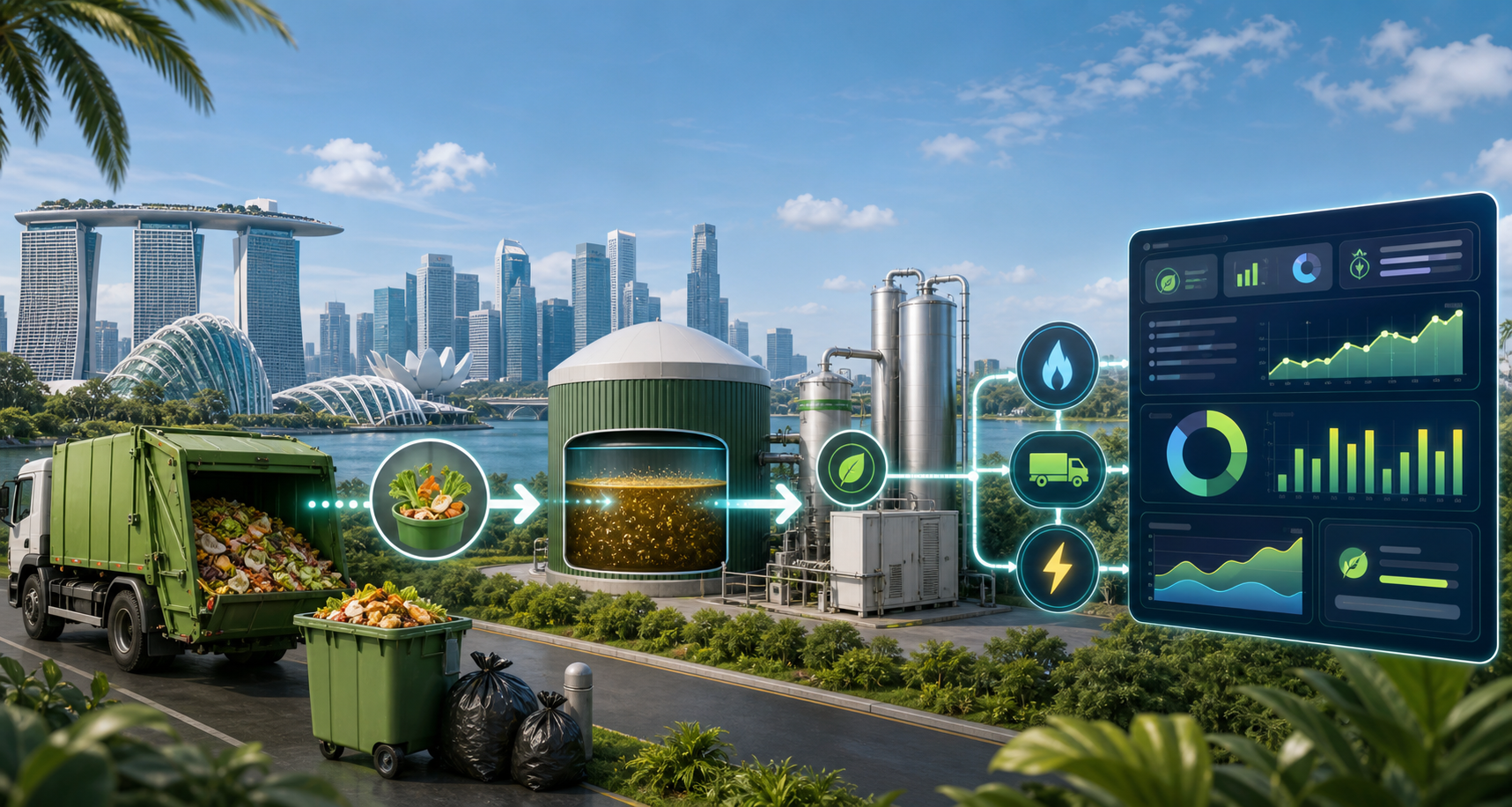
Singapore developers should compare multiple pathways before choosing equipment. A compact anaerobic digestion model may produce biogas for electricity and heat, or it may justify upgrading and compression if Bio-CNG logistics and offtake are credible.
Electricity can be attractive where facilities can consume power on-site, reduce purchased energy, and use heat. Bio-CNG or biomethane can be attractive when the project can aggregate clean food-waste feedstock, control contamination, and secure a buyer for higher-value gas.
The key is net value, not gross gas. Compression power, upgrading losses, engine efficiency, downtime, contaminant handling and maintenance costs can turn a good headline yield into a weak cash-flow model.
| Route | Best Singapore fit | Model carefully |
|---|---|---|
| Biogas to electricity | On-site energy users, campuses, industrial kitchens | Net kWh, uptime, heat use, internal load |
| Biogas to Bio-CNG | Fleet/logistics use cases or aggregated offtake | Upgrading capex, compression power, gas quality |
| Centralized AD | District or multi-generator collection | Collection radius, contamination, land and permitting |
| On-site treatment | Large malls, hotels, processors, institutions | Space, odor, operations, reporting discipline |
Read: convert biogas m3 to kWh and CHP revenue · Read: Bio-CNG conversion cost and payback
What a Singapore feasibility model should include
A Singapore food-waste biogas model should include daily tonnes available, separation quality, moisture, volatile solids, methane yield, expected biogas volume, energy route, capex, opex, maintenance, power tariff, labor, land or floor-space cost, avoided disposal cost and contract structure.
The most important sensitivity is feedstock quality. Food waste has strong methane potential, but contamination, packaging, salt, variable fats, and acidic loads can create process risk. A realistic model should test conservative, base and optimized cases.
Bioflux is useful here because the calculator workflow separates feedstock assumptions, gas output, revenue, and reporting. That lets a Singapore user test a mall, hotel, processor or multi-site waste contractor scenario without building a fragile spreadsheet.
Compare food waste and co-feedstock assumptions · Estimate biogas, Bio-CNG and electricity output · Stress-test Singapore revenue and payback
Tuas Nexus is the signal: integration matters
Singapore’s Tuas Nexus / Integrated Waste Management Facility is a useful strategic signal because the plan includes co-located waste and water treatment infrastructure and a source-segregated food-waste treatment stream. The lesson for private projects is not to copy the scale, but to copy the thinking: integrate waste, water, energy and reporting.
For private-sector developers, that means the strongest business cases may come from clusters: food processing zones, hospitality portfolios, institutional campuses, logistics kitchens, or district-level commercial waste aggregation.
In those cases, the model should compare decentralized treatment against aggregation, and energy self-use against external offtake. The winner depends on local operations, not global averages.
Singapore’s food-waste opportunity is not about copying rural biogas economics. It is about high-density organic waste, compliance reporting, integrated treatment, and scenario discipline. Model the tonnes, contamination, energy route and payback before choosing the technology.
Frequently asked questions
How much food waste does Singapore generate?
NEA waste statistics show Singapore generated about 784,000 tonnes of food waste in 2024, with a food-waste recycling rate of about 18%. That makes source segregation and treatment a major opportunity area for modeling.
Can Singapore food waste be used for biogas or Bio-CNG?
Yes, source-segregated food waste can be modeled for anaerobic digestion, biogas, electricity, heat, Bio-CNG or biomethane. The commercial case depends on contamination control, daily tonnes, logistics, capex, opex, power tariff and offtake.
What should a Singapore biogas calculator include?
It should include food-waste tonnes per day, methane yield, biogas volume, kWh or Bio-CNG output, avoided disposal assumptions, treatment costs, energy tariff, capex, opex, payback and sensitivity cases.
Use Bioflux to model a Singapore food-waste case: start with the feedstock calculator, estimate gas in the biogas calculator, then test payback in the ROI calculator.
Model a Singapore food waste project
Singapore food waste feedstock calculator
food waste to biogas calculator
Singapore biogas ROI calculator
Also read: Biogas to electricity calculator
Also read: Bio-CNG conversion cost and payback
Share: #Singapore #FoodWaste #Biogas #BioCNG #CircularEconomy #Bioflux
Source: NEA waste statistics and recycling rates