Learning Center
Membrane Separation vs. PSA: Which Upgradation Technology Maximizes Your 5 TPD CBG Plant ROI?
By GrowDiesel · May 15, 2026
When planning a 5 TPD (tons per day) compressed biogas (CBG) plant, developers often spend months debating feedstock logistics. Yet the most bankability-critical decision frequently happens after the anaerobic digester: choosing your gas upgradation technology. With a typical 5 TPD grid-quality plant carrying a substantial capex framework, the choice between membrane separation and pressure swing adsorption (PSA) is not only an engineering call—it directly shapes daily methane recovery, opex per kilogram, and your timeline to full ROI.
Methane recovery efficiency: the cost of slippage
The target metric for any commercial upgradation unit is compliance with IS 16087 standards, requiring a minimum methane (CH₄) concentration of about 90%—ideally scaling past 93% to 96% for vehicle-grade fuel.
The primary difference between membrane and PSA systems lies in how much methane is lost during scrubbing—referred to as methane slippage.
Membrane separation: the high-yield premium
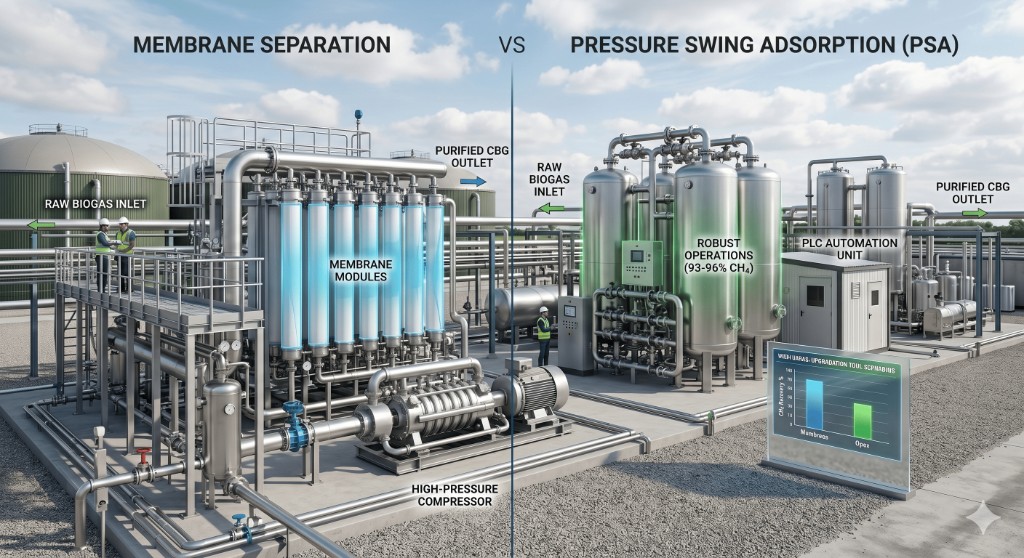
Membrane systems pass raw, desulfurized biogas through polymeric hollow-fiber modules. Because CO₂ molecules permeate through the polymer much faster than methane, the train can achieve very high purification when pre-treatment is disciplined.
Methane recovery: typically about 98% to 99.5%.
ROI impact: minimal methane escapes in the off-gas stream—nearly every cubic meter of methane your digester produces can become saleable product when the system is sized and operated correctly.
Pressure swing adsorption (PSA): the robust standard
PSA systems use carbon molecular sieves (CMS) or zeolites under alternating pressure cycles to trap CO₂ and moisture while allowing methane to pass through.
Methane recovery: typically about 92% to 96%.
ROI impact: a 4% to 8% methane slippage band means a measurable share of energy potential is vented with waste CO₂ gas or must be recycled through a secondary recovery stage, adding operational complexity.
Capex vs. opex: balancing lifecycle costs
A true financial model must weigh lower entry cost against long-term operational overhead—not just module price tags.
| Financial metric | Membrane systems | PSA systems |
|---|---|---|
| Initial capital (capex) | Higher (premium modules) | Lower / competitive |
| Daily power (opex) | Higher compression demand | Moderate / lower |
| Consumables / replacement | Membrane lifespan (sensitive) | Low (long-lasting CMS) |
The PSA cost architecture
PSA is historically favored by developers looking to keep initial deployment costs lean. Structural components are durable, and molecular sieve media can last well over a decade when inlet gas is free of hydrogen sulfide (H₂S) and moisture.
PSA often operates at relatively moderate pressures, which can keep immediate electrical opex lower than multi-stage membrane compression—especially where tariffs are punitive.
The membrane cost architecture
Membranes require high multi-stage compression to force gas through microscopic polymer walls, which raises parasitic electrical load.
Membranes are sensitive to chemical degradation: if pre-treatment fails to catch trace siloxanes or elevated H₂S ppm, replacing a ruined membrane stack can materially hit quarterly cash flow—model replacement reserves, not best-case lifetimes.
Feedstock volatility and gas-flow turndown
Industrial plants rarely see perfectly stable conditions. Seasonality in agricultural residues or shifts in municipal food-waste collections change daily raw biogas flow rates.
PSA flexibility: highly adaptable to variations in raw gas quality and flow velocity. If digester output drops ~20% during a cold snap or delayed feedstock delivery, PLC automation on a PSA unit can often alter cycle timings to maintain output quality.
Membrane constraints: membranes operate best at tight design pressures and consistent volumes. Running significantly below rated volumetric capacity can lower separating efficiency—gas purity may dip unless buffer storage and compression staging are engineered into the layout.
The bankability verdict: which technology wins?
Choose membrane separation if feedstock is expensive to procure (for example purchased press mud) and you cannot afford to waste even a single percentage point of gas yield. Near-perfect methane recovery can offset higher module capex within the first ~3 years of continuous operation in many 2026 planning bands.
Choose PSA upgradation if you are building where electricity tariffs dominate lifecycle cost, or if you run a multi-feedstock layout with highly volatile daily gas composition and need robust turndown behavior.
Either path still fails bank review when recovery, power, and offtake are assumed—not calculated.
Model gas flow and upgradation assumptions in the Bioflux gas & CBG calculator · Stress-test payback with the Bioflux revenue & ROI calculator
Membrane and PSA are not winners in the abstract—they are winners in your tariff, feedstock, and turndown context. Map exact gas flows, technology parameters, and local energy costs before you present a business case to banks or investors.
Frequently asked questions
What methane recovery should I assume for membrane vs PSA on a 5 TPD CBG plant?
Planning bands often use roughly 98–99.5% recovery for well-operated membrane trains versus about 92–96% for PSA, but guarantees depend on inlet H₂S, moisture, siloxanes, and vendor design—always model slippage as a sensitivity, not a brochure number.
Does IS 16087 drive the choice between membrane and PSA?
Both technologies can reach IS 16087-grade methane concentrations (about 90%+), but the cost of getting there differs: membranes optimize yield; PSA often optimizes capex and electrical opex when pre-treatment is excellent.
How much can a 2% methane recovery gap change payback?
At industrial scale, a 2% recovery shortfall or an unmodeled 0.5 kWh/kg compressor penalty can push payback out by roughly a year—exact impact depends on gate price, uptime, and feedstock cost, which is why side-by-side scenario modeling matters.
A 2% drop in methane recovery or an uncalculated compressor penalty can shift payback by a full year. Model membrane vs PSA side by side in the Bioflux gas & CBG calculator and revenue calculator, then export PDF briefs for engineering and finance teams.
Launch the Bioflux gas & capacity workspace
biogas to Bio-CNG conversion calculator
Also read: Biogas to Bio-CNG conversion cost blueprint (2026)
Also read: How to calculate biogas plant ROI in 2026
Also read: Feedstock wars 2026 — which substrate delivers the best ROI?
Also read: Commercial Bio-CNG upgrading showdown (membrane vs PSA)
Share: #CBGPlant #MembraneSeparation #PSA #BioCNG #BiogasUpgradation #BiogasFlux