Learning Center
Food Waste vs. Cow Dung: Which Feedstock Actually Doubles Your Biogas Yield? (2026 Data)
By SEO Manager & Biogas Expert at GrowDiesel · April 17, 2026
In Bio-CNG planning, not all organic matter performs the same. Cow dung remains operationally reliable, but co-digestion strategies are helping modern plants increase gas output significantly without increasing digester size. Selecting the wrong feedstock mix can severely impact lifetime project returns.
The feedstock reality check
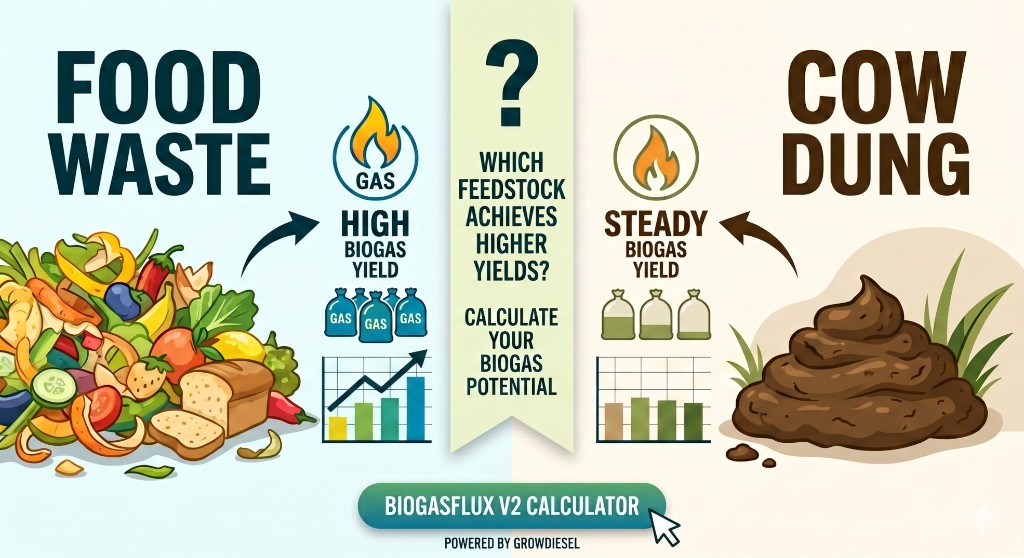
Plant efficiency depends primarily on volatile solids and the Carbon-to-Nitrogen ratio. Cow dung provides microbial stability and predictable handling but lower yield, while sorted food waste carries higher energy potential from fats and carbohydrates.
In practical terms, cow dung is process-stable baseline substrate, and food waste is a high-energy booster that can materially lift methane output when controlled correctly.
Biogas potential comparison per tonne
Cow dung (fresh): 25-45 m3/tonne at ~55% methane.
Poultry litter: 70-100 m3/tonne at ~60% methane.
Food waste (sorted): 120-160 m3/tonne at ~65% methane.
Maize silage: 180-220 m3/tonne at ~52% methane.
Why the right mix beats single-feedstock planning
The highest ROI usually comes from co-digestion, not single-stream feeding. A representative strategy of 80% cow dung with 20% high-energy food waste can improve methane output meaningfully while preserving process stability.
This lift is driven by improved microbial synergy and better substrate balance, not by simply chasing maximum yield feedstock in isolation.
Calculate your exact ratio before plant design
Reference tables are useful, but real outputs vary based on moisture, solids concentration, retention time, and operating temperature. Model your actual ratios before fixing digester capacity or committing capex.
Use the Bioflux calculator to simulate your feedstock blend and project Bio-CNG output with current conversion assumptions.
Treat your digester as a controlled biochemical system, not a generic waste pit. Yield gains begin with feedstock math and verified scenario planning.
Open the Bioflux Yield Calculator