Learning Center
Biogas to Bio-CNG Conversion: The 2026 Cost vs. Output Blueprint
By SEO Manager & Biogas Expert at GrowDiesel · April 19, 2026
The transition from raw biogas to Bio-CNG (compressed biogas) is often the single highest-leverage decision for profitability in 2026. Raw biogas works well for decentralized power or thermal use, but Bio-CNG is what unlocks long-term OMC offtake routes and policy-aligned revenue. The open question is whether upgradation capex is justified by the uplift in price, offtake certainty, and by-product economics.
The physics of profit: what is the actual output?
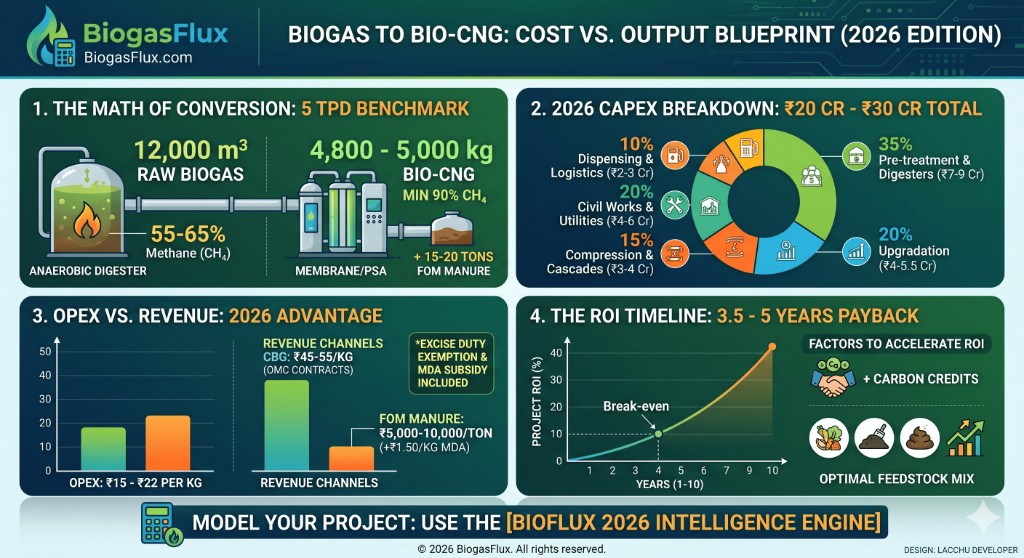
Economics starts with conversion efficiency. Raw biogas is commonly about 55% to 65% methane (CH₄). Indian Bio-CNG quality expectations under IS 16087:2016 require pushing methane to a minimum of about 90% in the product gas, which means separation of CO₂, H₂S, moisture, and trace contaminants during upgradation.
The 5 TPD (tons per day) benchmark: if your anaerobic digester produces about 12,000 m³ of raw biogas per day, the methane volume in that stream is roughly 7,200 m³ (at ~60% CH₄). After purification and compression pathways typical for grid-quality CBG, a practical planning range for saleable Bio-CNG is often about 4,800 kg to 5,000 kg per day for that class of project, depending on recovery, losses, and operating choices.
The “loss” is not wasted energy in a naive sense: you remove CO₂ and H₂S to raise methane concentration, which increases energy density and marketability even though volumetric flow drops through the upgrading train.
Run the 5 TPD benchmark in the Bioflux gas & CBG capacity calculator
2026 capex breakdown: where the money goes
A Bio-CNG project is not only an upgradation skid. For a 5 TPD class plant, total project capex commonly clusters around ₹20 Cr to ₹30 Cr in 2026 planning bands, with large swings driven by feedstock handling, land, grid connection, and whether digesters are greenfield or retrofitted.
Membrane-based upgradation has become a common 2026 reference technology due to strong methane recovery and a relatively compact footprint versus older water-scrubbing trains, though the right choice still depends on gas composition, turndown, and vendor guarantees.
| Component | % of total capex | Estimated cost (5 TPD) |
|---|---|---|
| Pre-treatment & digesters | 35% | ₹7.0–₹9.0 Cr |
| Upgradation (membrane / PSA) | 20% | ₹4.0–₹5.5 Cr |
| Compression & cascades | 15% | ₹3.0–₹4.0 Cr |
| Civil works & utilities | 20% | ₹4.0–₹6.0 Cr |
| Dispensing & logistics | 10% | ₹2.0–₹3.0 Cr |
Opex vs. revenue: the 2026 advantage
The 2026 advantage is not only gate price: excise positioning for CBG and market development assistance (MDA) for organic manure can materially change net cash flow when modeled honestly alongside power, staffing, and feedstock logistics.
Operational cost (opex) for CBG plants is often quoted in planning discussions in the ₹15–₹22 per kg range for the CBG product, inclusive of electricity, labor, maintenance, and feedstock collection complexity—verify against your specific energy tariff and transport radius.
Revenue stream 1 (CBG): indicative SATAT-linked offtake discussions frequently reference roughly ₹45–₹55 per kg depending on contract structure, escalation, and quality compliance—treat these as scenario inputs, not guarantees.
Revenue stream 2 (FOM): fermented organic manure is increasingly modeled as a standalone line item. With MDA support at about ₹1.50 per kg in policy framing, a 5 TPD plant can add meaningful annual cash flow from manure alone when marketing and logistics are solved—not as a footnote.
SATAT scheme — official MoP&NG overview
The ROI timeline: is it worth it?
For many bankable models in 2026, payback lands near 3.5 to 5 years when feedstock is stable, uptime is credible, and both gas and manure are contracted—not when only one revenue line is “real.”
1. Feedstock mix: food waste or press mud can lift gas yield versus plain cow dung, which changes sizing and revenue per rupee of capex.
2. Carbon credits: verified credits can add incremental dollars per ton CO₂-equivalent avoided, but only if MRV and offtake contracts are aligned with buyer requirements.
3. Efficiency: each 1% improvement in methane recovery during upgradation can move annual margin materially at scale—model it, do not assume it.
Conclusion: math is the best consultant
Bio-CNG is not only an environmental upgrade; it is a financial structuring exercise. A small error in feedstock energy calculations can shift payback by years, which is exactly why scenario modeling beats static templates.
Stop guessing and start modeling.
Use the Bioflux 2026 Intelligence Engine to input your specific feedstock availability, local electricity rates, and transport distance. Get a bank-ready ROI report in seconds.