Early 2026 sharpened the signal for Czech biomethane: a major European Commission–backed financing package—widely reported around €3.7 billion—targets the country’s transition from legacy biogas toward grid-ready biomethane at scale. That capital wave overlaps with stronger market coupling and new language-ready tooling, which matters if you are modeling projects for English-speaking global investors or for Czech developers who need local regulatory vocabulary without losing engineering precision.
The €3.7 billion Czech biomethane surge (2026 context)
Policy narratives in early 2026 center on a large EC-approved Czech scheme—commonly summarized around €3.7 billion—aimed at accelerating biomethane production and related infrastructure rather than subsidizing heat-only biogas indefinitely.
Public reporting on the package frequently ties it to a production ambition on the order of 350 million cubic meters through 2030, which is the right order of magnitude for investors building demand curves—but always reconcile headlines with grant rules, eligible capex, and commissioning timelines before you lock financing.
Parallel discussions in the market also reference two-way contract-for-difference (CfD) mechanisms for renewable gases in Europe. Treat CfD language as a structuring hypothesis until your counsel confirms how Czech implementation maps to your specific offtake and balancing strategy.
A growing investment landscape
The investment environment in Czechia has become notably more stable and promising for the green gas sector as policy, private capacity, and EU capital align on the same direction: higher-value gas products, better waste utilization, and infrastructure that can absorb new supply.
Governmental support is concrete: the national Action Plan for Biomethane Development targets transforming roughly half of the country’s existing biogas stations into advanced biomethane facilities by 2030—an explicit signal that legacy heat-led assets are expected to upgrade or rationalize.
On the private side, major operators are scaling fast. By mid-2026, major players like the Energy Financial Group (EFG) are set to reach an annual capacity of 116 GWh of biomethane and process over 94,000 tonnes of biodegradable waste—evidence that feedstock logistics and upgrading trains are moving from pilot narratives to operating reality.
European integration and infrastructure tailwinds
Czechia’s participation in the ALPACA project links its energy balancing markets more tightly with Germany and Austria. For investors, that integration matters: deeper liquidity and cross-border competition can improve price discovery and reduce single-market risk—especially for biomethane and related certificates where regional arbitrage and offtake options increasingly drive returns.
Separately, the EU’s recent allocation of roughly €401 million to support green district heating schemes in the country strengthens the downstream pull for low-emission heat and gas—reinforcing the circular-economy story that turns agricultural and food waste into reliable energy services rather than disposal costs.
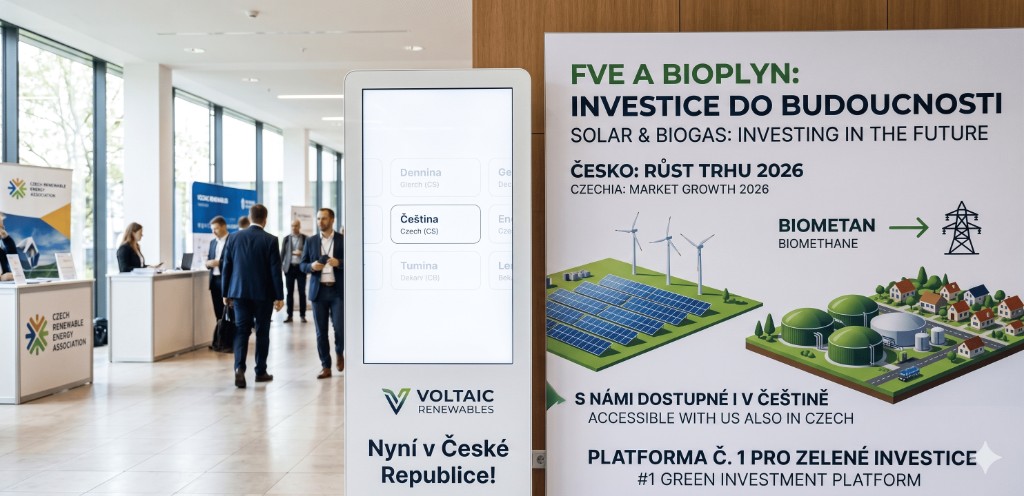
Vítejte — Czech (Čeština) is live on Bioflux
To match the pace of Central European market growth, Bioflux now fully supports Czech (Čeština) across tools, reports, and dashboard workflows—including the language selector experience shown in our Czech UI imagery for this launch.
Whether you are an investor reviewing the Bohemian biogas market or a local developer sizing the next generation of upgrading and injection assets, you can navigate the platform in your native language—reducing friction when teams mix international capital with domestic execution.
Why localized product depth matters
Local accuracy: Czech regulatory and market terminology shows up consistently in the experience, which reduces misinterpretation when you move from headline policy to line-item assumptions.
Seamless collaboration: reports and inputs can be shared with Czech-speaking stakeholders without forcing a second “translation layer” outside the product.
Expanded reach: Central Europe is central to the EU’s renewable gas build-out; language support is part of meeting operators where they work, not only where they invest from.
Stay tuned as we continue to expand global coverage and support the teams building a sustainable gas grid—starting with clearer tools in every market that is scaling for real.
常见问题
What is the 2026 Czech biomethane subsidy?
It is a €3.7 billion scheme approved by the European Commission to support Czech biomethane scale-up, with public reporting often citing a target on the order of 350 million cubic meters of production through 2030. Always verify eligibility, auction timing, and stackability with national programs before you model bank covenants.
Does this platform support Czech users?
Yes. Bioflux fully integrates Čeština (Czech) across calculators, saved reports, and dashboard settings so local developers and international partners can collaborate in one language surface.
Log in and open dashboard settings to switch your interface language to Čeština and run calculators in Czech today.
Also read: Biogas to Bio-CNG conversion blueprint (2026)
Also read: Multilingual, multi-currency project software
Share: #CzechEnergy #Biometan2026 #RenewableInvestment #BiogasCzech #GreenTech #Čeština