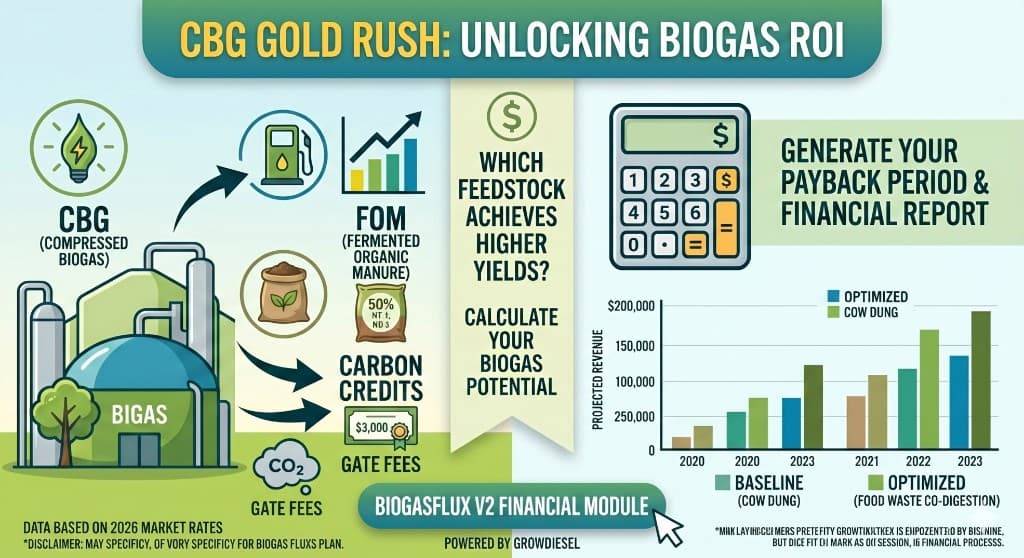
Compressed biogas has moved from niche pilot economics to serious infrastructure opportunity. But many projects fail not from poor demand, but from weak financial modeling that misses costs, by-product upside, and downside scenarios.
The three revenue pillars of a modern CBG plant
A credible model must include all core revenue streams: compressed biogas sales, fermented organic manure monetization, and potential carbon-credit cash flow where applicable.
Developers who model gas only frequently understate project upside and misrepresent resilience across commodity cycles.
ROI reality for a 5 TPD class project
Capex remains significant, but payback periods can compress materially when gate fees, internal energy savings, and by-product sales are modeled correctly.
Well-structured projects with disciplined assumptions are increasingly targeting payback windows in the ~3.5 to 4.5 year range instead of legacy 7-year expectations.
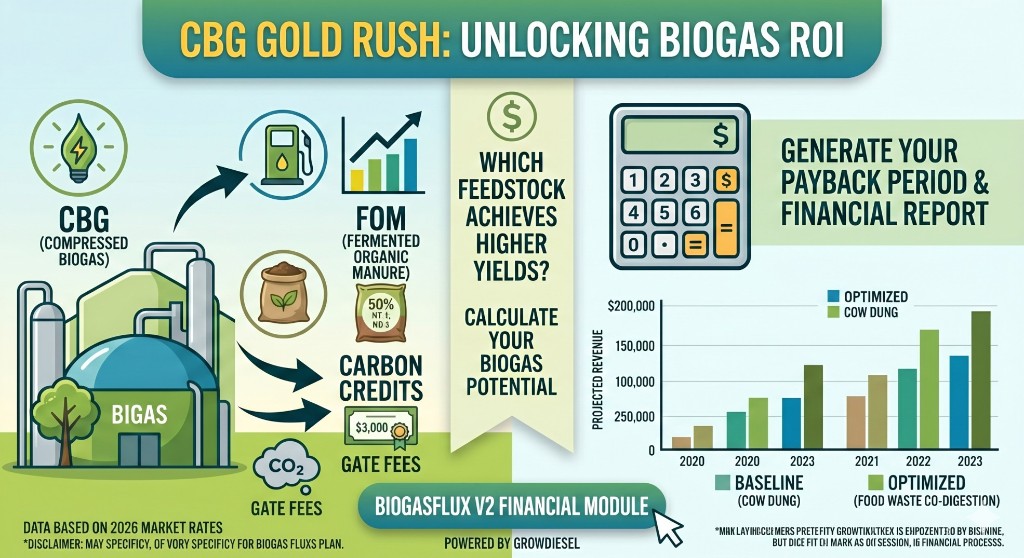
What investors need before approving capital
Back-of-the-envelope projections are rarely fundable. Lenders typically require scenario analysis showing sensitivity to feedstock cost inflation, uptime variance, gas quality deviations, and policy-linked pricing shifts.
Robust downside and stress cases increase financing confidence and reduce execution risk post-commissioning.
Model with precision, not assumptions
Bioflux provides integrated gas conversion, market-linked revenue projection, and emissions-linked impact estimates so your feasibility model stays decision-grade.
Use it to pressure-test assumptions before design freeze, debt applications, and EPC finalization.
The CBG opportunity is real, but precision protects capital. Build your project plan on scenario-backed calculations, not optimistic averages.
常见问题
What revenue streams should a CBG ROI model include in 2026?
A credible model typically includes compressed biogas sales, fermented organic manure monetization, and carbon-credit scenarios where methodology and offtake are real—gas-only models often misstate upside and resilience.
What payback window is realistic for a disciplined 5 TPD class project?
Well-structured projects with honest assumptions increasingly target payback in the roughly 3.5 to 4.5 year range when by-products and policy-linked lines are modeled correctly, versus legacy seven-year templates.
What do lenders usually require beyond a single base case?
Expect sensitivity analysis on feedstock inflation, uptime variance, gas quality deviations, and policy-linked pricing—stress cases materially affect financing confidence.
Check your project feasibility in Bioflux