शिक्षण केंद्र
Agricultural Residue vs. Press Mud: Which is Better for Industrial CBG?
GrowDiesel · ८ मे, २०२६
As the global push for Compressed Biogas (CBG) intensifies, plant operators are moving beyond traditional manure. Two heavyweights dominate the industrial conversation: agricultural residue (for example paddy straw) and press mud, the sugar industry’s organic by-product. Both offer massive scale, but they impose very different technical and financial constraints—so the right choice is rarely ideological; it is geographic, seasonal, and capex-dependent.
The power of press mud: the "sugar gold"
Press mud has become a favorite for CBG plants in sugar-producing regions such as Uttar Pradesh and Maharashtra.
High energy density: press mud often shows strong biomethane potential (BMP) because it retains residual sugars and digestible organic matter from the milling train.
Ease of digestion: unlike raw straw, press mud is already partially conditioned by the sugar process, which can shorten the path to stable gas production in many digester designs.
Logistics advantage: it is a concentrated waste stream from a single point—the mill—which reduces the cost and complexity of aggregating feedstock from thousands of farms.
Agricultural residue: the volume giant
With field burning of crop residues under intense regulatory and environmental pressure, converting straw into biogas is both a national priority and a feedstock-security strategy.
Abundant supply: millions of tonnes of paddy and wheat straw are available annually, making residue one of the most scalable bulk options where collection and storage can be solved.
Carbon-market narrative: projects that credibly displace field burning can strengthen the case for higher-integrity carbon credits—but only with defensible MRV, baselines, and offtake alignment.
The lignin challenge: straw is structurally tough. Mechanical, thermal, or chemical pre-treatment is often required to expose cellulose and improve hydrolysis so bacteria can access the energy—adding capex and opex that must be in the model.
Carbon credit aggregators: MRV, scale, and offtake for biogas projects
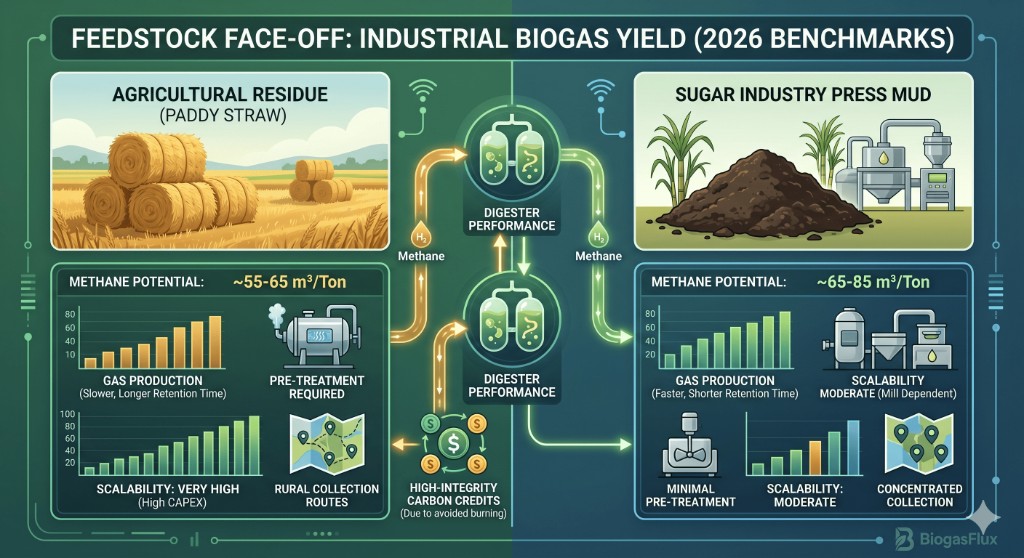
Technical comparison: at a glance
Indicative planning bands below; always confirm with lab BMP, supplier variability, and your digester configuration.
| Metric | Press mud | Agricultural residue (straw) |
|---|---|---|
| Methane yield (indicative) | High (~60–80 m³/tonne) | Medium (~50–65 m³/tonne) |
| Pre-treatment | Minimal | Often required (higher cost) |
| Retention time | Shorter (faster gas) | Longer (slower gas) |
| Availability | Seasonal (sugar season) | Seasonal (harvest window) |
Which should you choose?
Choose press mud if you are within roughly 50 km of a reliable sugar mill and can contract volume through the season. The combination of strong gas yield and lower pre-treatment burden is often the fastest route to credible ROI when logistics are solved.
Choose agricultural residue if you are sizing for very large throughput (for example 5+ tonnes CBG per day class plants) and feedstock security matters more than minimizing front-end process complexity—but only if you budget real pre-treatment, storage, and ash-handling systems.
The BiogasFlux advantage
The right blend is not a headline—it is a number. BiogasFlux helps teams move from opinion to scenarios:
Simulate mixes: model ROI for recipes such as 70% press mud and 30% straw to test biological balance, gas stability, and procurement cost.
Multi-currency analysis: compare feedstock procurement and gas revenue across major currencies without rebuilding spreadsheets.
Local execution: generate technical reports in multiple languages so local engineers and international investors share one quantitative baseline.
The 2026 trend: co-digestion
Most new industrial plants are not choosing a single hero feedstock—they are designing for co-digestion, using press mud to boost the effective yield of lignin-heavy residues while residues diversify supply beyond the sugar calendar.
Press mud and agricultural residue both belong in the 2026 industrial toolbox; the winning design is usually the one that matches mill proximity, pre-treatment capex, and seasonal storage—with co-digestion as the default engineering mindset.
Run your own mix scenarios in the Bioflux revenue calculator or gas yield calculator before you lock digesters and upgrading trains.
Also read: Carbon credit aggregators for biogas producers
Also read: Food waste vs cow dung biogas yield
Also read: Feedstock wars 2026 — which substrate delivers the best ROI?
Also read: Calculate biogas plant ROI (carbon credits & FOM)
Share: #CBG2026 #PressMud #CropResidue #Biogas #BioCNG #CoDigestion #BiogasFlux