शिक्षण केंद्र
Why Digital Modeling is the Secret to Scaling Biogas Production Profitably
GrowDiesel · २४ मे, २०२६
In the race toward global decarbonization, biogas and biomethane are no longer alternative-energy footnotes—they are mainstream economic powerhouses. Yet as the industry scales, developers and operators hit a frustrating bottleneck: unpredictable feedstocks, volatile market pricing, and plant models built on static spreadsheets, PDFs, and guesswork. If you want serious investment and maximum methane yield in today’s market, static data will not cut it. You need dynamic, real-time, localized intelligence—and digital modeling is how leading teams get there.
De-risking feedstock volatility
The biggest variable in any anaerobic digestion (AD) project is feedstock. Whether you process agricultural residue, municipal solid waste, or industrial wastewater, chemical composition changes constantly—and traditional static models assume perfectly consistent input.
In reality, moisture content fluctuates, organic loading rates spike or drop, and substrate costs vary by season and region. That uncertainty is where margin and bankability quietly erode.
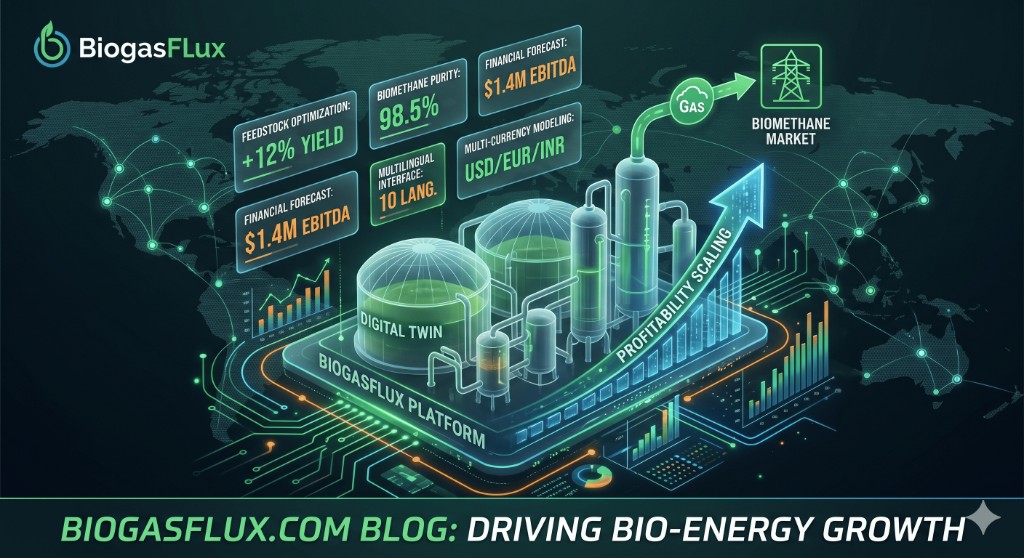
Advanced digital modeling lets operators run disciplined what-if scenarios before trucks arrive: What if corn silage costs jump 15%? What if you substitute 20% of current feedstock with food waste? A modern intelligence suite forecasts methane potential (CH₄) and volatile fatty acid balances from your actual recipe bands—not brochure averages.
Navigating a multi-currency, global market
The biogas boom is not centralized. A project may be engineered in Europe, funded from New York, and built in Southeast Asia or Latin America—each layer adding local regulations, grid tariffs, and multi-currency reporting complexity.
Modern analytical suites address this with localized dashboards: toggle between USD, EUR, INR, GBP, and other execution currencies without rebuilding spreadsheets, then export compliance-ready PDF analytics for investors who need precision, not rough conversion factors.
For project developers pitching global capital, language and currency localization is not a UX nicety—it is how you keep engineering assumptions and financial narratives aligned across borders.
Read: BiogasFlux multi-language and multi-currency project software
Optimizing the "biogas-to-biomethane" financial pivot
With Bio-CNG growth and strict grid-injection standards, upgrading raw biogas to high-purity biomethane is where much of the revenue upside lives—but upgrading capex is steep and unforgiving if modeled optimistically.
Digital modeling acts as a financial sandbox: stress upgrading technology choices, balance plant opex (especially compression and power) against market premiums for green gas certificates, and find the point of diminishing returns before you lock equipment.
The planning question is not only cubic meters of gas produced—it is net-positive financial yield per hour once recovery, power, and offtake are honest.
| Decision lens | Static spreadsheet risk | Digital modeling advantage |
|---|---|---|
| Feedstock mix | Single average composition | Scenario bands by season, price, and substitution |
| Upgrading train | Brochure recovery assumptions | Recovery vs power vs certificate price sensitivities |
| Investor reporting | Manual FX and translation layers | Localized PDFs and multi-currency baselines |
| Scale-up | Copy-paste errors across sites | Repeatable templates per geography |
Run biomethane yield and upgrading assumptions in the gas calculator · Stress-test payback in the Bioflux revenue & ROI workspace
The future is adaptive, not static
The era of rigid, single-language, single-currency software for million-dollar renewable gas infrastructure is over. Developers scaling internationally need platforms that adapt with operations—not decks that freeze assumptions at financial close.
At Biogasflux, we built an intelligence suite for this era: high-fidelity digital models, comprehensive PDF analytics, and bio-fuel production optimization with localized language and currency support so teams can move from guesswork to defensible decisions.
Whether you are an operator tightening digestion performance, an investor screening cross-border portfolios, or a developer packaging the next commercial AD asset, the competitive edge is the same—model volatility before it hits the P&L.
Scaling biogas profitably is a data problem dressed as an engineering problem. Digital modeling turns feedstock volatility, global finance, and biomethane upgrading into scenarios you can defend—to your board, your lender, and your operations team.
वारंवार विचारले जाणारे प्रश्न
What is biogas digital modeling?
Biogas digital modeling uses dynamic, scenario-based tools to simulate feedstock mixes, digestion performance, upgrading recovery, and financial outcomes—replacing static spreadsheets that assume constant inputs and average market prices.
How does digital modeling help with feedstock volatility?
It lets you run what-if analyses on moisture, loading rate, substrate cost, and substitution recipes before committing procurement—forecasting methane potential and process stability from your actual bands rather than a single average.
Why does multi-currency modeling matter for biomethane projects?
Cross-border projects are often engineered, funded, and operated in different currencies and regulatory contexts. Localized dashboards and exportable analytics keep capex, opex, tariffs, and investor reporting consistent without manual conversion errors.
Stop scaling on static assumptions. Run feedstock, gas, and revenue scenarios in the Bioflux revenue calculator and gas & CBG workspace, then export localized PDF analytics for your next investor conversation.
Explore the Biogasflux platform
feedstock biogas yield calculator
biomethane and CBG capacity calculator
Also read: Biogas project management software — 9 languages & multi-currency ROI
Also read: Feedstock wars 2026 — which substrate delivers the best ROI?
Also read: Biogas to Bio-CNG conversion cost blueprint (2026)
Also read: How to calculate biogas plant ROI in 2026
Share: #Biogas #RenewableEnergy #SystemDesign #GreenTech #Biomethane #BiogasFlux