ಕಲಿಕಾ ಕೇಂದ್ರ
Membrane Separation vs. PSA: The Commercial Bio-CNG Upgrading Showdown
GrowDiesel · ಮೇ 21, 2026
For commercial biogas developers upgrading raw biogas into grid-quality biomethane or compressed Bio-CNG, the upgrading train is often the single largest driver of long-term operational profitability. Membrane separation and pressure swing adsorption (PSA) dominate the market—but the right choice depends on power consumption, methane recovery, consumable life, and the utility tariffs at your site. Here is how they compare on the exact data points Bioflux models for project viability.
Methane recovery rate and methane slip
Upgrading efficiency determines how much revenue never reaches the meter. Methane that is not recovered is lost to atmosphere, flare, or recycle loops—and shows up directly in your yield model.
Membrane separation: typically about 98.5% to 99.5% methane recovery. The remaining 0.5% to 1.5% is methane slip. Even a 1% slip compounded over ten years can be material unless off-gas is recycled to a secondary stage or the digester.
PSA systems: typically about 96% to 98.5% recovery. Carbon molecular sieves trap methane during adsorption; a slightly higher fraction can leave with the depressurization exhaust during desorption cycles.
Power consumption (specific electricity demand)
Upgrading moves gas through pressure cycles—your industrial electricity tariff often sets the monthly opex floor.
Membrane separation (high pressure): gas is compressed to roughly 8 to 16 bar to force CO₂ through polymeric hollow-fiber membranes. Indicative specific electricity consumption is often about 0.25 to 0.35 kWh per Nm³ of raw biogas.
PSA (moderate pressure): adsorption columns commonly run near 4 to 7 bar. Indicative specific consumption is often about 0.20 to 0.28 kWh per Nm³ of raw biogas because the train does not force permeation through a membrane wall.
Maintenance, consumables, and lifespan
Replacement timing changes IRR and maintenance reserves in any bankable model.
Membrane separation: few moving parts day to day, but membranes are sensitive to moisture, VOCs, and H₂S if pre-treatment slips. Fouling can be irreversible. Many operators plan full membrane stack replacement every 5 to 8 years.
PSA: carbon molecular sieve (CMS) media can last 10 to 15+ years when protected from oil aerosols and water. The trade-off is mechanical complexity—fast-acting switching valves cycle constantly and need routine service to avoid pressure leakage.
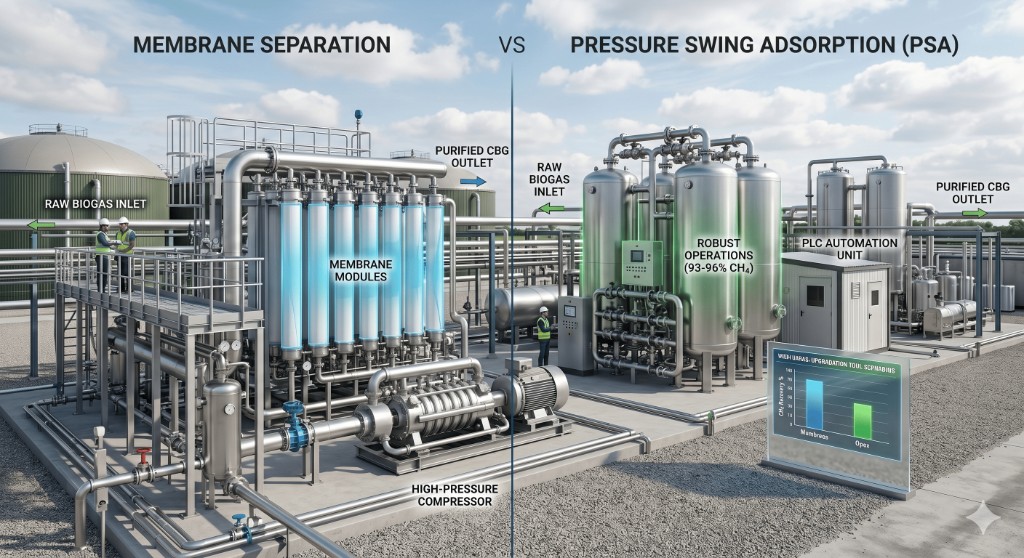
Head-to-head technical matrix
Use the matrix below as planning bands; vendor guarantees and inlet gas quality still govern final performance.
| Feature / metric | Membrane separation | Pressure swing adsorption (PSA) |
|---|---|---|
| Typical CH₄ purity | > 97% to 99% (often very consistent) | > 96% to 98% (can move with flow swings) |
| Pre-treatment requirement | Extremely strict (near-zero moisture/VOC tolerance) | Strict (reliable water vapor removal) |
| Turndown capacity | Excellent (often efficient ~40–100% of design flow) | Moderate (efficiency can fall on deep turndown) |
| Start-up time | Minutes to reach saleable purity | Often 30–60 minutes to pressurize and stabilize columns |
The financial swing: how local tariffs rewrite the math
There is no universal winner—location and utility constraints pick the technology.
High electricity tariffs tend to favor PSA when lower specific energy consumption reduces monthly opex more than the extra methane slip costs in lost product.
High feedstock cost or scarce gas volume tends to favor membranes when every Nm³ matters and a 2–3% yield gap versus PSA erodes margins faster than a higher power bill.
Cheap captive power (for example behind-the-meter solar at the plant) can shift the balance back toward membranes if recovery dominates your revenue line.
Run the exact analytics in Bioflux
Do not lock technology on brochure averages. Bioflux is built to run the engineering and financial math your calculators already use: local industrial tariffs, hourly raw gas flow, inlet purity bands, and Bio-CNG price scenarios.
Stress membrane replacement cycles versus PSA valve maintenance in a multi-year view, then export a localized comparison your engineering and finance teams can defend.
Open the Bioflux gas & CBG capacity calculator · Run 10-year revenue and payback in the Bioflux revenue calculator
Membrane separation and PSA are both proven commercial paths to Bio-CNG—the winner is the one that matches your recovery needs, pre-treatment discipline, and local power economics. Calculate both before you commit capex.
ಪದೇ ಪದೇ ಕೇಳಲಾಗುವ ಪ್ರಶ್ನೆಗಳು
What is a typical methane slip for membrane vs PSA upgrading?
Membrane trains often plan about 0.5–1.5% slip (98.5–99.5% recovery), while PSA commonly plans roughly 1.5–4% slip (96–98.5% recovery), depending on column design, desorption management, and inlet contaminants.
How much power does membrane upgrading use compared with PSA?
Indicative bands are about 0.25–0.35 kWh/Nm³ raw biogas for membranes (higher pressure) versus about 0.20–0.28 kWh/Nm³ for PSA (moderate pressure). Plug your actual tariff into Bioflux—small differences compound monthly.
Which technology is better when electricity is expensive?
High tariffs often tilt toward PSA if lower kWh/Nm³ saves more opex than membranes recover in extra methane—but the answer reverses when feedstock is costly and yield dominates margin. Model both paths with your real flow and price.
Plug your electricity tariff, raw gas flow, feed gas purity, and Bio-CNG price into the Bioflux gas & CBG calculator and revenue & ROI workspace for a localized lifecycle comparison.
Compare upgrading scenarios in Bioflux
RNG and biomethane yield calculator
Also read: Membrane vs PSA for 5 TPD CBG plant ROI
Also read: Biogas to Bio-CNG conversion cost blueprint (2026)
Also read: How to calculate biogas plant ROI in 2026
Share: #BioCNG #MembraneSeparation #PSA #BiogasUpgrading #Biomethane #BiogasFlux