Centro risorse
Carbon Credit Aggregators: How Biogas Producers Pool MRV and Reach Buyers (2026)
Di GrowDiesel · 8 maggio 2026
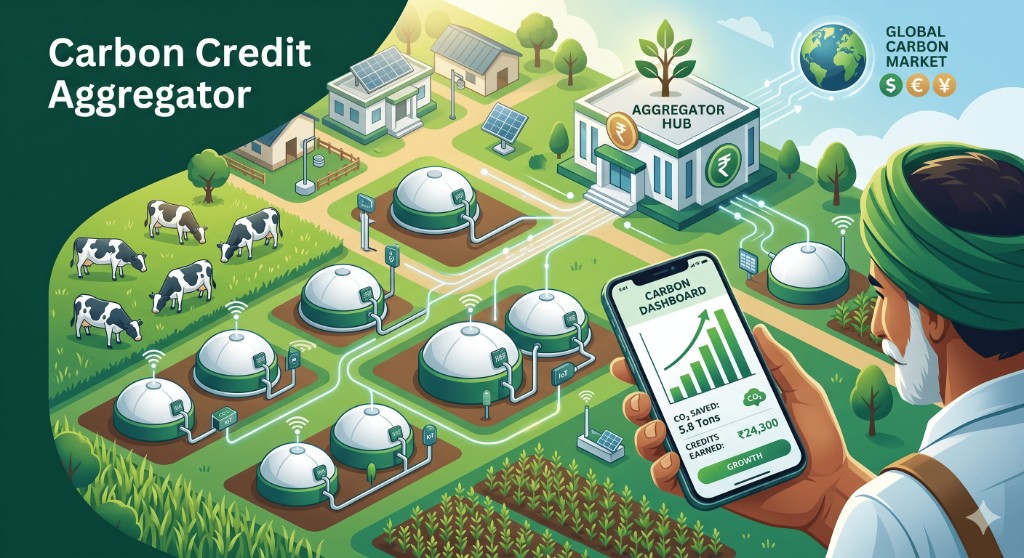
Individual biogas and CBG sites often generate real greenhouse-gas benefits—methane capture, avoided open burning, fossil displacement—but voluntary carbon markets reward clarity: consistent measurement (MRV), defensible baselines, and issuance at a scale buyers actually want. Aggregators exist to close that gap by pooling many small producers behind one disciplined data and commercial stack.
Why aggregation matters for digesters
Buy-side diligence is expensive. A single village-scale or farm-scale digester can produce meaningful abatement, but verification, registry interaction, and contract negotiation are often larger than the project’s administrative budget.
An aggregator standardizes data collection, quality control, and issuance—then sells credits (or structured offtake) in larger, more liquid parcels. For operators, the trade is typically a share of revenue for reduced operational burden and better access to reputable buyers.
What “good” looks like in 2026
Expect scrutiny on additionality, permanence (where relevant), leakage, and conservative baselines—especially for agricultural residue pathways where open burning is the counterfactual.
IoT and operational telemetry can strengthen credibility when they tie directly to mass balances, gas flows, and uptime—not vanity dashboards. The goal is an audit trail that matches engineering reality.
How this connects to your plant economics
Carbon revenue should be modeled as a scenario, not a certainty: price paths, issuance lags, and buyer concentration all matter. The right aggregator partner is one whose methodology fit, fee structure, and buyer network match your feedstock story and scale.
For industrial CBG teams comparing press mud, straw, or co-digestion, the carbon narrative is often strongest where you can prove a clear, monitored displacement of high-emission business-as-usual practices.
Aggregators do not replace sound engineering—they make methane MRV and commercialization repeatable. Pair a credible biological design with a credible measurement story, and carbon can become a real line item instead of a slide-deck fantasy.
Model gas, manure, and carbon scenarios together in the Bioflux revenue calculator and 2026 ROI playbook.
Also read: Agricultural residue vs press mud for industrial CBG
Also read: Calculate biogas plant ROI in 2026
Also read: Feedstock wars — methane yield & co-digestion
Share: #CarbonCredits #Biogas #CBG #MRV #VoluntaryCarbonMarket #BioCNG #BiogasFlux